A blue alga, or cyanobacteria, is the
simplest living being in earth. It belongs to prokaryote. And it can resist
severe living standard and last for thousands of thousands of years.
The four most important properties predestinate cyanobacteria as the one of the most important life form to not only biological evolution, but also to the development of human society and science and technology. They are – the simplest structure, the widest metabolism, the most extensive distribution, the most ancient history.
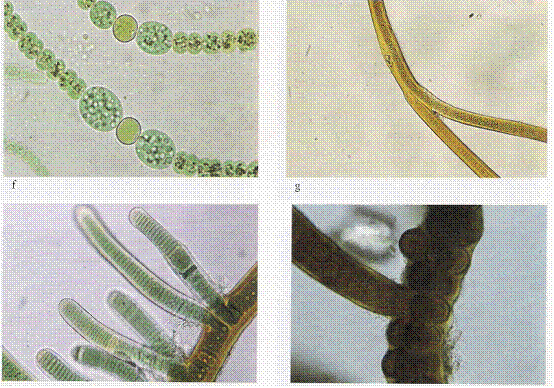
A variety of shapes
Application
1. Food
Blue algae has been recommended by the UN as the most
ideal food sources for the 21st century. It is nutrious, full of
protein, and can be used not only by human, but by animals and plants as well.
2. Meds
Blue algae have demonstrated its abilities in defending cancer in some of its species. And genetic engineering will certainly enhance its such ability according to human needs.
3. Protect the Environment
Blue algae can be used to absorb harmful elements such as radioactive material and poisonous chemicals in water.
4. Renewable biofuel
Biofuel has been rapidly developing nowadays. But environmentalists keep different views in its advantages and disadvantages. As the price for oil is rising, the price for biofuel becomes competitive and more farmers are willing to sell their crops to power plants rather than sell them as food. Therefore, an increasing food crisis is occurring in countries whose governments take little regulation on the usage of farm products or pay little compensation to farmers who sell crops as food. Therefore, instead of replacing traditional fuel such as oil and coal, fighting global warming and curing carbon emission, biofuel turns out to be the enemy to human beings’ survives in many people’s eyes. But because people seldom take blue algae as their main food sources, making blue algae as biofuel has specific advantage, and blue algae is much easier than crops to grow, and contains a much higher rate of oil when compared to ordinary crops. According to VOA broadcast, Germany has recently build a power plant based on blue algae ad biofuel, which can produce the same amount of energy lower in price than ordinary fuels like petroleum and gases. Blue algae used as biofuel is no longer a project in lab, but a reality and is broadening its way to serve human beings’ essential needs of energy.
5. Mode organism
Blue algae is so simple, small and easy to feed, therefore people tend to make experiments on them to do genetical research, especially gene expression.
Blue
algae transgenic engineering
The most exciting usage of blue algae mentioned on the above applications is that it can be used to express exterior genes that are ‘planted’ on blue algae. There are commonly several ways to induce exterior genes into the algae cells. One common way is electric shock. But the efficiency of gene expression is a world class difficulty. Several sectors of transgene are listed below. First, only a few can integrate with new genes when many samples are infused with exterior genes. Among the few ‘mixed’ algae cells, only a few can express exterior genes. And among the very special species that can express exterior genes, only a few can survive after such a severe operation. Therefore, only those which can sustainable express exterior genes are the species people want. Therefore, the efficiency to induce and express exterior genes is a problem that greatly lags the progress of f genetic engineering behind. Therefore, we are going to use laser technology and optical tweezers technology to help improve the situation. Firstly, laser is much more accurate and less harmful than electric shock in perforating membrane or nuclear membrane. And optical tweezers offer us pN class force to move specific small object such as vectors that carry exterior DNA. And this kind of orientation greatly improves the efficiency for exterior DNA to be integrated into receptor DNA. With two sections of the process of transgene been improved, the speed of genetic engineering will certainly be greatly improved.
Main
difficulty
Laser has been used as scalpel to make microsurgery on tissues and cells. And the technology to use laser to perforate cell membrane is mature and guarantees a low harmful effect on the cells. Optical tweezers usually deals with particles around μm in size. Therefore the vectors may be so small to be accurately captured by the optical tweezers. What’s more, as most vectors are biomacromolecules, ordinary microscope cannot catch sight of such small object, let alone capture them by optical tweezers and move them around. Therefore large vectors and receptors have to be found.
Cooperator
and current research
Prof Shi Dingji from Institute of Plant of Chinese Academy of Sciences and Ocean Institute of Tianjin Univ of Science is an expert in blue algae genetical engineering. He proposed this issue after we introduces him our laser and optical tweezers technology. He is greatly interested in transgene research of blue algae by using laser technology, and he believes that our technology might help improve efficiency in transgene research. So we have the cooperation to use physic methods – laser to help solve transgene problem. The very first important thing is to master skills of cell culturing, not simply because that experiment need a lot of sample, but also because that after transgene operation, blue algae cells are very vulnerable and cannot survive for long is not well protected. The environment it needs is so strict that everything including temperature and nutrition should be taken care control of. I studied how to culture cells during my second half of junior year in college. A graduate, Xue Guosheng, is sent to Prof Shi’s lab to study cell culture technology systematically for half a year. And after this step is undertaken, we can test our idea in research on transgene by laser. The latest experiment will not start until Xue comes back at the end of the year 2009.